Science And Sciencibility

where each text is a hypertext link

Tuesday, 31 May 2022

Physicists trace the rise in entropy to quantum information

The second law of thermodynamics expresses a fundamental truth about the Universe — that entropy, a measure of disorder, will always increase. Now some physicists are proposing that the law comes about because of quantum effects such as entanglement. In this telling, an increase in entropy is not just the most likely outcome of change, it is a logical consequence of quantum behaviour.


Posted by Dr CLÉiRIGh at 00:00
Email ThisBlogThis!Share to XShare to FacebookShare to Pinterest
Labels: Physics

Saturday, 28 May 2022

Black-hole image sheds light on Milky Way mysteries

The first image of our Galaxy’s supermassive black hole, released earlier this month, has already begun to explain some enduring mysteries about the heart of the Milky Way. Alongside other evidence, the results suggest that Sagittarius A* is sucking in matter at a slow pace, making it unusually dim compared with the central black holes of other galaxies. The observations also hint that Sagittarius A* could have been spectacularly active only a few million years ago. And there are fresh questions about some of the largest structures seen in and around the Milky Way.

Posted by Dr CLÉiRIGh at 00:00
Email ThisBlogThis!Share to XShare to FacebookShare to Pinterest
Labels: Astronomy

Friday, 27 May 2022

‘Mind blowing’ ancient settlements uncovered in the Amazon

The southwest corner of the Amazon Basin was once the site of complex urban settlements built by ancient civilisations. Researchers used a laser remote-sensing technology called lidar to map land inhabited by the Casarabe culture, which existed around AD 500 to 1400 in what is now Bolivia. Observations from the air reveal that Casarabe people lived in densely populated centres, featuring 22-metre-tall earthen pyramids, that were encircled by kilometres of elevated roadways. They also had large water-management infrastructure made of canals and reservoirs.

Posted by Dr CLÉiRIGh at 00:00
Email ThisBlogThis!Share to XShare to FacebookShare to Pinterest
Labels: Archæology

Saturday, 21 May 2022

Can galaxies form without dark matter?

Scientists think that galaxies cannot form without the gravitational pull of dark matter. But astronomers might have observed a line of 11 galaxies that don’t contain any dark matter, which could all have been created in an ancient collision. Some are unconvinced that the claim is much more than a hypothesis.

Posted by Dr CLÉiRIGh at 07:00
Email ThisBlogThis!Share to XShare to FacebookShare to Pinterest
Labels: Astronomy

Thursday, 19 May 2022

Ancient tooth suggests Denisovans ventured far beyond Siberia

A fossilised tooth unearthed in a cave in northern Laos might have belonged to a young Denisovan girl who died between 164,000 and 131,000 years ago. If confirmed, it would be the first fossil evidence that Denisovans — an extinct hominin species that co-existed with Neanderthals and modern humans — lived in southeast Asia. The molar would be only the second Denisovan fossil found outside Siberia, but millions of people with Asian, Oceanian or Pacific Islander ancestry carry traces of Denisovan DNA.

Posted by Dr CLÉiRIGh at 00:00
Email ThisBlogThis!Share to XShare to FacebookShare to Pinterest
Labels: Anthropology, Palæontology

Sunday, 15 May 2022

Ancient DNA maps ‘dawn of farming’

Europe’s first farming populations descend mostly from farmers in the Anatolian peninsula, in what is now Turkey. And the ancient Anatolian farmers descended from repeated mixing between distinct hunter-gather groups from Europe and the Middle East. A pair of ancient-DNA studies — including one of the largest assemblages of ancient human genomes yet published — reveal finer details of the dawn of farming, thanks to ‘high coverage’, or high-quality, genomes — a rarity in ancient-genomics work.

Posted by Dr CLÉiRIGh at 00:00
Email ThisBlogThis!Share to XShare to FacebookShare to Pinterest
Labels: Archæology, Genetics

Saturday, 14 May 2022

Origin of life theory involving RNA–protein hybrid gets new support

Chemists say they have solved a crucial problem in a theory of life’s beginnings, by demonstrating that RNA molecules can link short chains of amino acids together. This might have allowed for ever-more complex RNAs, proteins and combinations of the two — a possible path to the chemistry of life that we know today. The findings support a variation on the ‘RNA world’ hypothesis, which proposes that, before DNA evolved, the chemical ancestors of biological life were based on RNA.

Posted by Dr CLÉiRIGh at 00:00
Email ThisBlogThis!Share to XShare to FacebookShare to Pinterest
Labels: Biology, Chemistry

Friday, 13 May 2022

Black hole at the centre of our Galaxy imaged for the first time

Below is Sagittarius A* — the black hole at the centre of our galaxy. It’s only the second time a black hole has been directly imaged. Like the first such image — of the supermassive black hole at the centre of a nearby galaxy called M87, in 2019 — astronomers created the picture by processing radio-wave observations that are invisible to the human eye. The long-awaited results were obtained from data collected in 2017 by the Event Horizon Telescope, a global network of radio observatories. Sagittarius A* seems to be rotating anticlockwise along an axis that roughly points along the line of sight to Earth.

Posted by Dr CLÉiRIGh at 00:00
Email ThisBlogThis!Share to XShare to FacebookShare to Pinterest
Labels: Astrophysics

Thursday, 12 May 2022

Bats buzz like hornets to scare off owl predators

Some bats can imitate the sound of buzzing hornets to scare off owls — the first documented case of a mammal mimicking an insect to deter predators. Researchers compared the sound structure of buzzing by the European hornet (Vespa crabro) to that of the distress call of greater mouse-eared bats (Myotis myotis). At most frequencies, the two sounds were not dramatically similar, but they were when the bat’s call was stripped down to include only frequencies that owls can hear.

Posted by Dr CLÉiRIGh at 00:00
Email ThisBlogThis!Share to XShare to FacebookShare to Pinterest
Labels: Ethology, Semiosis

Thursday, 5 May 2022

A ‘galaxy’ is unmasked as a pulsar

An object that astronomers thought was a distant galaxy is actually the brightest extra-galactic pulsar ever seen. Pulsars are among the few celestial objects that emit circular polarised light, so scientists used a computer program that works like sunglasses: it filters out other kinds of light. The team could then spot the ‘hidden’ pulsar.

Posted by Dr CLÉiRIGh at 00:00
Email ThisBlogThis!Share to XShare to FacebookShare to Pinterest
Labels: Astronomy

Friday, 22 April 2022

Fossil hints at colourful pterosaur feathers

A remarkable fossil reveals that pterosaurs might have been covered in brightly coloured feathers. The exquisitely preserved Tupandactylus imperator shows the soft tissues of the animal’s crest and filament structures that suggest that it had true feathers. The fossil also preserves melanosomes: tiny organelles that contain melanin and cause much of the colouring in features and skin. Researchers found different types of melanosome, suggesting that it sported various colours — and that its feathers weren’t just to keep it warm.

Posted by Dr CLÉiRIGh at 00:00
Email ThisBlogThis!Share to XShare to FacebookShare to Pinterest
Labels: Palæontology

Friday, 15 April 2022

Blind cave fish have regional accents

In the underground caves of north-eastern Mexico, groups of blind fish that communicate using clicks seem to be developing cave-specific accents. Researchers studying the Mexican tetra (Astyanax mexicanus) analysed hours of fish chatter in six caves spread across the three mountain ranges. They noticed significant differences: clicks were relatively high-pitched in one cave, and deep and booming in another, for example. The linguistic split could eventually contribute to ongoing speciation among the fish.

Posted by Dr CLÉiRIGh at 00:00
Email ThisBlogThis!Share to XShare to FacebookShare to Pinterest
Labels: Semiosis

Thursday, 14 April 2022

Simulation hints at how climate shaped human migration

A record-breaking simulation of the past two million years of Earth’s climate provides evidence that temperature and other planetary conditions influenced early human migration — and possibly contributed to the emergence of the modern-day human species around 300,000 years ago.

Posted by Dr CLÉiRIGh at 00:00
Email ThisBlogThis!Share to XShare to FacebookShare to Pinterest
Labels: Anthropology

Wednesday, 13 April 2022

An interstellar object exploded over Earth in 2014

Declassified US government data confirm that a small meteorite that blazed through the skies over Papua New Guinea in 2014 came from far beyond our Solar System. In 2019, researchers argued that the object’s high speed and trajectory suggested that it originated from another star system. But the study was never peer-reviewed because the data needed to verify the calculations were classified. The confirmation by US government officials makes the meteorite the first interstellar object to be detected in our Solar System, spurring scientists to consider a search for shards of the object that might have settled on the sea floor.

Posted by Dr CLÉiRIGh at 00:00
Email ThisBlogThis!Share to XShare to FacebookShare to Pinterest
Labels: Astronomy

Saturday, 9 April 2022

W boson’s surprise mass threatens to upend the standard model

Physicists analysing data from a long-defunct experiment have found that the W boson — a fundamental particle that carries the weak nuclear force — is notably heavier than theory predicts. Although the difference between the theoretical prediction and experimental value is only 0.09%, it is significantly larger than the result’s error margins, which are less than 0.01%. The finding also disagrees with some other measurements of the mass. If it is confirmed by other experiments, it could be the first major breach in the standard model of particle physics, a theory that has been spectacularly successful since it was introduced in the 1970s.

Posted by Dr CLÉiRIGh at 00:00
Email ThisBlogThis!Share to XShare to FacebookShare to Pinterest
Labels: Physics

Friday, 8 April 2022

Can mushrooms ‘speak’?

Researchers who tapped into the network that connects fungi say that its patterns of electrical signals resemble human speech. Previous studies have suggested that fungi use electrical signals to communicate and process information across tiny connective threads called mycelium. In the new study, researchers inserted tiny electrodes into substrates colonised by four species of fungi. They found that spikes of electrical activity often clustered into groups that resembled vocabularies of up to 50 words and could be similar to human language. But some researchers are sceptical.


Blogger Comments:

Although this is unlikely to be evidence of a semiotic system, let alone a language, it may well be a precursor to semiotic systems, where what is exchanged is social value, rather than symbolic value. Such systems, previously thought to be exclusive to animals, have more recently been identified in some plants.
Posted by Dr CLÉiRIGh at 00:00
Email ThisBlogThis!Share to XShare to FacebookShare to Pinterest
Labels: Biology, Semiosis

Thursday, 7 April 2022

Mystery warriors made the fastest migration in ancient history

Around 1,500 years ago, horse-riding warriors known as the Avars appeared in southeastern Europe seemingly out of nowhere and established an empire lasting more than 200 years. Now, DNA evidence suggests that they crossed a continent in the span of a decade or two. Human remains from Avar tombs in what is now Hungary closely match those from an individual buried just a few decades earlier in what is now eastern Mongolia — almost 7,000 kilometres away.

Posted by Dr CLÉiRIGh at 00:00
Email ThisBlogThis!Share to XShare to FacebookShare to Pinterest
Labels: Archæology

Friday, 1 April 2022

Scientists classify manatee vocalisations

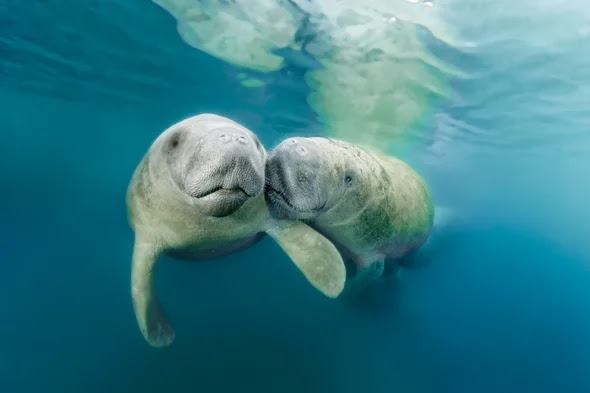
Researchers listened to seven years of manatee (Trichechus manatus latirostris) chat to learn how the gentle, solitary grazers communicate. Almost all of the creatures’ vocalisations fall into three categories: a high squeak used between mother and calf, a lower squeak that indicated stress and a squeal recorded during “cavorting” and “frisky behaviour”.

Posted by Dr CLÉiRIGh at 00:00
Email ThisBlogThis!Share to XShare to FacebookShare to Pinterest
Labels: Ethology, Semiosis

Saturday, 26 March 2022

Bizarre space circle captured in unprecedented detail

Astronomers have captured a rare image of ‘odd radio circles’, rare space objects made up of gigantic rings of radio waves. Only five of these massive balls of radio waves have ever been spotted, with most containing a galaxy at their centre. Researchers have proposed three theories to explain their origin: they are created from shock waves, radio jets or starbursts in the centre of their galaxies.

Posted by Dr CLÉiRIGh at 00:00
Email ThisBlogThis!Share to XShare to FacebookShare to Pinterest
Labels: Astronomy

Wednesday, 23 March 2022

Liquid metal, ruby and sapphire could rain down on huge exoplanet

A hot, giant exoplanet, called WASP-121b, could experience ruby and sapphire rain. Astronomers developed a three-dimensional model of the planet based on observations taken from a spectroscopic camera aboard the Hubble Space Telescope. The exoplanet has a hot day side that always faces its star, and whips around in an orbit of just 30 hours. Winds could be blowing vapourised titanium and aluminium from the hot side to the night side, where it rains down as droplets of liquid metal, ruby and sapphire.

Posted by Dr CLÉiRIGh at 00:00
Email ThisBlogThis!Share to XShare to FacebookShare to Pinterest
Labels: Astronomy

Wednesday, 9 March 2022

A Deepening Crisis Forces Physicists to Rethink Structure of Nature’s Laws

Particle physicists, who study nature’s fundamental building blocks, are in crisis. The relationship between the Higgs boson and phenomena at the highest energy scales — those associated with the quantum nature of gravity, black holes and the Big Bang — just doesn’t feel right. The equations require extreme fine-tuning — of a type that physicists dub ‘unnatural’ — to work out in a way that reflects observations. Some physicists think this failure of ‘naturalness’ signals the breakdown of reductionism — that the laws of physics at big scales emerge from those at smaller scales.


Blogger Comments:

This misunderstands reductionism. Reductionism is the misinterpretation of a compositional hierarchy as reducing to its lowest level, as when physicists say nonsense like 'we are nothing but elementary particles'.
Posted by Dr CLÉiRIGh at 00:00
Email ThisBlogThis!Share to XShare to FacebookShare to Pinterest
Labels: Physics

Thursday, 3 March 2022

Tyrannosaurus rex may have been three species

Tyrannosaurus rex might not have been one species, but three. Palæontologists studying 37 T. rex specimens say there is too much variation in their ‘stout build’ and teeth to be a single species. Instead, they propose that fossils found in lower layers of rock are probably from a species they call Tyrannosaurus imperator, and slender-boned specimens are likely from a creature they’ve named Tyrannosaurus regina. The work has prompted widespread discussion, but many palæontologists are not convinced.

Posted by Dr CLÉiRIGh at 00:00
Email ThisBlogThis!Share to XShare to FacebookShare to Pinterest
Labels: Palæontology

Friday, 25 February 2022

Largest bacterium ever discovered has an unexpectedly complex cell

A newly discovered bacterium, Thiomargarita magnifica, challenges the definition of a microbe: its filament-like single cell is up to 2 centimetres long. T. magnifica achieves its unprecedented size by having unique cellular features: two membrane sacs. One is filled with its genetic material; the other, which is much larger, helps to keep its cellular contents pressed up against its outer cell wall so that the molecules it needs can diffuse in and out. Researchers have dubbed these sacs ‘pepins’ — inspired by the pips in fruit — and note that they blur the line between single-celled prokaryotes and eukaryotes (the group that includes humans), which pack their DNA into a nucleus.
Posted by Dr CLÉiRIGh at 00:00
Email ThisBlogThis!Share to XShare to FacebookShare to Pinterest
Labels: Biology

Thursday, 24 February 2022

Largest Jurassic pterosaur discovered

The largest pterosaur fossil from the Jurassic Period has been uncovered in Scotland. The new species of flying reptile, Dearc sgiathanach, lived about 170 million years ago and had a wingspan of 2.5 metres — roughly the size of an albatross. Pterosaurs evolved 230 million years ago as small reptiles and eventually grew to be massive creatures with 12-metre wingspans by the Cretaceous Period, 145 million years ago. The new fossil helps to fill a gap in this dinosaur’s history because pterosaur fossils from the Middle Jurassic are very rare.

Posted by Dr CLÉiRIGh at 00:00
Email ThisBlogThis!Share to XShare to FacebookShare to Pinterest
Labels: Palæontology

Wednesday, 16 February 2022

How light is a neutrino?

Physicists are closer than ever to nailing down the mass of the elusive neutrino. A team at the Karlsruhe Tritium Neutrino (KATRIN) experiment in Germany found that neutrinos have a maximum mass of 0.8 electron volts. Researchers have long had indirect evidence that these mysterious particles should be lighter than 1 eV, but this is the first time that this has been shown in a direct measurement. The experiment has so far been able to put only an upper bound on the mass. But researchers might be able to make a definite measurement once it finishes collecting data in 2024.

Posted by Dr CLÉiRIGh at 00:00
Email ThisBlogThis!Share to XShare to FacebookShare to Pinterest
Labels: Physics

Tuesday, 15 February 2022

Earth-like planet spotted orbiting Sun’s closest star

Astronomers have discovered a third planet orbiting Proxima Centauri, the star closest to the Sun. Called Proxima Centauri d, the newly spotted world is probably smaller than Earth, and could have oceans of liquid water.

Posted by Dr CLÉiRIGh at 00:00
Email ThisBlogThis!Share to XShare to FacebookShare to Pinterest
Labels: Astronomy

Friday, 11 February 2022

Evidence of Europe’s first Homo sapiens found in French cave

Archæologists say they have found evidence that Homo sapiens lived briefly in a rock shelter in southern France — before mysteriously vanishing. New research suggests that distinctive stone tools and a lone child’s tooth were left by our species during a short stay some 54,000 years ago — and not by Neanderthals, who lived in the rock shelter for thousands of years before and after that time. The Homo sapiens occupation, which researchers estimate lasted for just a few decades, pre-dates the previous earliest known evidence of the species in Europe by around 10,000 years. But not everyone is convinced, and the tooth’s DNA has not been analysed to confirm its origins.

Posted by Dr CLÉiRIGh at 00:00
Email ThisBlogThis!Share to XShare to FacebookShare to Pinterest
Labels: Archæology

Wednesday, 9 February 2022

First glimpse of an isolated black hole

Astronomers have, for the first time, seen an isolated black hole, wandering unattached across the Milky Way. Lone black holes probably litter the Galaxy, but they’re extremely hard to spot because they are typically observed as they interact with other objects, such as companion stars. Confirming the black hole’s presence took ten years of observations, focusing on how the object’s extreme gravitational pull warps the light from distant stars behind it.

Posted by Dr CLÉiRIGh at 00:00
Email ThisBlogThis!Share to XShare to FacebookShare to Pinterest
Labels: Astronomy

Friday, 4 February 2022

Direct evidence of two types of water

Water is unlike most other liquids on Earth: it has at least 66 weird properties, including high surface tension, high heat capacity, high melting and boiling points and low compressibility. Some chemists have come to think of it as not being one liquid at all, but two distinct liquid phases that coexist in a mixture. Now, physicists might have made the first direct observation of the transformation between the two states, in supercold water mixed with trehalose, a natural antifreeze that keeps the liquid from freezing.

Posted by Dr CLÉiRIGh at 00:00
Email ThisBlogThis!Share to XShare to FacebookShare to Pinterest
Labels: Chemistry, Physics

Tuesday, 1 February 2022

How a disappearing ear bone turned bats into masters of echolocation

Some bats have an anatomical quirk in their ears that could explain how they evolved to hunt in specialized ways, from sensing small fish to catching insects midflight. In 2015, researchers took 3D images of the inner ear of a bat skull but couldn’t find a feature shared by almost all mammals: a bony tube that connects the ear to the brain and encases nerve cells. A more thorough search revealed many more bat species in which this bony nerve channel was missing or poked with large holes. Researchers suspect the loss of this bony channel gave the bats new hearing capabilities because the nerves are less confined.

Posted by Dr CLÉiRIGh at 00:00
Email ThisBlogThis!Share to XShare to FacebookShare to Pinterest
Labels: Biology, Semiosis

Monday, 31 January 2022

New way to detect gravitational waves

Astronomers could be on the verge of detecting gravitational waves using rapidly spinning stars called pulsars for the first time. The waves could show up as tiny variations in the frequency of the radio signals emitted by the stars. The technique could allow astronomers to observe the ripples in space-time caused by distant supermassive black holes that are millions or even billions of times larger than those spotted so far. The International Pulsar Timing Array (IPTA) collaboration has not yet found conclusive evidence of these gravitational waves, but it has detected a background signal hinting that researchers are progressing in the right direction.


Posted by Dr CLÉiRIGh at 00:00
Email ThisBlogThis!Share to XShare to FacebookShare to Pinterest
Labels: Astronomy

Sunday, 30 January 2022

Everyday objects can run artificial intelligence programs

Physicists have built neural networks by combining objects instead of using silicon chips. They work by taking advantage of the inherent physical properties of mechanical systems — such as the vibration of a metal plate.

Posted by Dr CLÉiRIGh at 00:00
Email ThisBlogThis!Share to XShare to FacebookShare to Pinterest
Labels: Physics, Technology

Saturday, 29 January 2022

A Nitrogen-Fixing Seagrass Discovered

Seagrass (Posidonia oceanica) has formed a symbiotic relationship with a marine bacterium in order to acquire an essential nutrient: nitrogen. It’s a survival strategy that has never before been seen in an aquatic plant. The seagrass co-evolved with the newly described microbe, Celerinatantimonas neptuna, similarly to how legumes solved the same conundrum on land. The discovery explains how seagrass can form vast meadows in coastal environments around the globe — and helps us to understand the best places to restore degraded ecosystems.


Blogger Comments:

Evolutionary change does not happen 'in order to' (purpose) but 'because' (reason and result).
Posted by Dr CLÉiRIGh at 00:00
Email ThisBlogThis!Share to XShare to FacebookShare to Pinterest
Labels: Biology, Botany

Friday, 28 January 2022

Did a mega drought topple empires 4,200 years ago?

In Mesopotamia in about 2200 BC, a mega drought lasted for decades or possibly even centuries. The drought might have contributed to the collapse of the Akkadian Empire, in what is now Syria and Iraq. But the drought’s extent is a matter of debate. Palæoclimatologists are working to pin down more details, which could hold clues to the kinds of natural droughts the world might face that could greatly exacerbate the impacts of climate change.

Posted by Dr CLÉiRIGh at 00:00
Email ThisBlogThis!Share to XShare to FacebookShare to Pinterest
Labels: Archæology, Palæoclimatology

Thursday, 27 January 2022

Ancient Crab Had Unusually Huge Eyes

A crab that paddled the ocean 95 million years ago had unusually keen vision thanks to its colossal bulbous eyes, according to a new study. The crab, Callichimaera perplexa, was only a few centimetres across but was probably a sharp-eyed predator.

Posted by Dr CLÉiRIGh at 00:00
Email ThisBlogThis!Share to XShare to FacebookShare to Pinterest
Labels: Palæontology

Wednesday, 26 January 2022

Hippo talk: study sheds light on purpose of call and response

Hippopotamuses recognise the voices of their pod-mates and members of nearby pods, and respond more territorially to strangers, according to a study in Mozambique. Scientists recorded and broadcast hippo “wheeze honks”, which sound like deep, resonant grunts. Animals were more likely to respond aggressively by spraying larger amounts of dung when they heard strangers. This suggests that if a hippo needs to be relocated for conservation reasons, it might help to make the local hippos a sort of ‘mix tape’ of the new hippo’s voice for them to listen to in advance, and vice versa.

Posted by Dr CLÉiRIGh at 00:00
Email ThisBlogThis!Share to XShare to FacebookShare to Pinterest
Labels: Semiosis

Wednesday, 19 January 2022

Earliest known human-made hybrid animal

A donkey-like animal that was highly prized by Mesopotamian elites might be the earliest known hybrid animal bred by humans. Researchers analysed the genome of these ‘kungas’, found buried alongside early Bronze Age royals in what is now Syria. The animals were the offspring of a female donkey (Equus africanus asinus) and a male Syrian wild ass (Equus hemionus hemippus), sometimes called a hemippe. The finding supports cuneiform texts that depict kungas as the product of complex animal husbandry programmes.

Posted by Dr CLÉiRIGh at 00:00
Email ThisBlogThis!Share to XShare to FacebookShare to Pinterest
Labels: Archæology, Genetics

Tuesday, 18 January 2022

Vast Cosmic Bubble Around the Sun Identified as Source of Baby Stars

We live inside a vast, expanding bubble, a hollow in the matter and radiation that exist in the space between the stars. This ‘local bubble’ is driven by the expanding shock waves of 15 supernovas that have occurred over the past 14 million years. And nearly all the new stars and stellar nurseries within 500 light years of Earth lie on its surface.

Posted by Dr CLÉiRIGh at 00:00
Email ThisBlogThis!Share to XShare to FacebookShare to Pinterest
Labels: Astronomy

Friday, 14 January 2022

Fossils Reveal When Animals Started Making Noise

The fossil record is revealing the first creatures that could hear and make noises. These include a 250-million-year-old insect that has the earliest known structures capable of producing sounds: drum-like membranes called tymbals, which can be contracted and relaxed to generate exceptionally loud clicks.

Posted by Dr CLÉiRIGh at 00:00
Email ThisBlogThis!Share to XShare to FacebookShare to Pinterest
Labels: Palæontology

Tuesday, 11 January 2022

Huge ichthyosaur fossil found

A gigantic prehistoric “sea dragon” discovered in the Midlands has been described as one of the greatest finds in the history of British palæontology. The ichthyosaur, which is about 180m years old with a skeleton measuring about 10 metres in length and a skull weighing about a tonne, is the largest and most complete fossil of its kind ever found in the UK.


Posted by Dr CLÉiRIGh at 00:00
Email ThisBlogThis!Share to XShare to FacebookShare to Pinterest
Labels: Palæontology

Friday, 7 January 2022

Stars may form 10 times faster than thought

A gas cloud could coalesce into a baby star ten times quicker than previously thought. Astronomers observed that the feeble magnetic fields outside the core of Lynds 1544, the beginnings of a star that’s forming in the Taurus Molecular Cloud, are even weaker than predicted. That gives gravity free rein in that region to crush enough gas together to spark nuclear fusion.

Posted by Dr CLÉiRIGh at 00:00
Email ThisBlogThis!Share to XShare to FacebookShare to Pinterest
Labels: Astronomy

Saturday, 18 December 2021

First millipede with more than 1,000 legs

Researchers in Australia have described the first reported millipede to live up to its name. The animal has 1,306 legs — breaking the previous record of 750 legs — and was found 60 metres underground in a mining area of Western Australia. It is pale and blind, with a long, thread-like body comprising up to 330 segments. Researchers named the species Eumillipes persephone, after the Greek goddess of the underworld, Persephone.

Posted by Dr CLÉiRIGh at 00:00
Email ThisBlogThis!Share to XShare to FacebookShare to Pinterest
Labels: Biology

Thursday, 16 December 2021

NASA spacecraft ‘touches’ the Sun for the first time ever

NASA’s Parker Solar Probe has travelled into the Sun’s corona — the first to have ever broached our star’s outer atmosphere. The Parker probe crossed the much-anticipated boundary, known as the Alfvén surface, on 28 April. It took several months for scientists to download the data and confirm the achievement.

Posted by Dr CLÉiRIGh at 00:00
Email ThisBlogThis!Share to XShare to FacebookShare to Pinterest
Labels: Astronomy, Astrophysics

Sunday, 12 December 2021

Oldest domestic dog remains in Americas

A tooth found in caves in Haida Gwaii in Canada is the earliest reported remains of a domestic dog in the Americas. Radiocarbon dating pinpoints the tooth’s age to 13,100 years ago — the oldest archæological evidence of human occupation in the area by 2,000 years. The findings stand alongside oral histories that record the Haida people’s long history on the islands. Researchers predict more discoveries to come, because the caves on the west coast of Canada are mostly unexplored by archæologists.

Posted by Dr CLÉiRIGh at 00:00
Email ThisBlogThis!Share to XShare to FacebookShare to Pinterest
Labels: Archæology, Palæontology

Saturday, 11 December 2021

DeepMind AI tackles one of chemistry’s most valuable techniques

The artificial-intelligence company DeepMind has developed a new machine-learning model to predict the density of a molecule’s electrons — a key step to calculating its physical properties. The algorithm relies on a technique called density functional theory (DFT), which has been hugely successful in chemistry, biology and materials science. But DFT goes a bit wonky in some cases, because it’s not a perfect reflection of the complex quantum mechanics that govern matter. Researchers trained an artificial neural network on data from hundreds of accurate solutions derived from quantum theory, plus some handy laws of physics.

Posted by Dr CLÉiRIGh at 00:00
Email ThisBlogThis!Share to XShare to FacebookShare to Pinterest
Labels: Chemistry, Physics, Technology

Wednesday, 8 December 2021

Newly Found Dinosaur Had a Battle Axe for a Tail

Chilean researchers have discovered a new species of ankylosaur in the subantarctic tip of Chile. Stegouros elengassen was about 2 metres long, with a relatively large head, slender limbs and a flat, frond-shaped tail unlike any seen before.

Posted by Dr CLÉiRIGh at 00:00
Email ThisBlogThis!Share to XShare to FacebookShare to Pinterest
Labels: Palæontology

Tuesday, 7 December 2021

Quantum Simulators Create a Totally New Phase of Matter

Physicists have created a physical simulation of an exotic and elusive state of matter first predicted in the 1970s, called a spin liquid. Spin liquids contain arrangements of electron spins — the subatomic equivalent of bar magnets — in a solid material that are intrinsically unstable, like the molecules in a liquid. Evidence for their existence is still preliminary, but researchers have now been able to simulate them using atoms suspended in a vacuum — a type of quantum computer that has received less attention than other technologies. Such ‘quantum simulations’ show promise as early applications of quantum computers.

Posted by Dr CLÉiRIGh at 00:00
Email ThisBlogThis!Share to XShare to FacebookShare to Pinterest
Labels: Physics, Technology

Monday, 6 December 2021

This tiny iron-rich world is extraordinarily metal

Astronomers have spotted the tiniest, most metal-based planet yet — an iron-rich world that is 9 parsecs away from Earth and zips around its star once every 8 hours. The planet, known as GJ 367b, is three-quarters the size of Earth, but much denser. Its temperature reaches a searing 1,500 ℃ during the day — nearly hot enough for its iron to begin to melt.

Posted by Dr CLÉiRIGh at 00:00
Email ThisBlogThis!Share to XShare to FacebookShare to Pinterest
Labels: Astronomy

Sunday, 5 December 2021

DeepMind’s AI helps untangle the mathematics of knots

Artificial-intelligence (AI) powerhouse DeepMind has teamed up with mathematicians to spot previously unseen patterns and seek new discoveries. Researchers trained a machine-learning algorithm on vast amounts of data about knots and revealed a formula linking two properties of knots — which the mathematicians then proved rigorously. In a separate test, the team found a potential pattern related to symmetries, which had been sought for decades.

Posted by Dr CLÉiRIGh at 00:00
Email ThisBlogThis!Share to XShare to FacebookShare to Pinterest
Labels: Mathematics, Technology

Saturday, 4 December 2021

Earth’s eccentric orbit paced the evolution of marine phytoplankton

Variations in Earth’s orbit might help to determine the evolution of marine phytoplankton. Researchers analysed fossils of coccolithophores that lived in the Pleistocene period (from 2.6 million to 11,700 years ago) alongside deviations in the circularity of Earth’s annual orbit, which cycles approximately every 100,000 and 400,000 years. They found that the diversity of plankton species increased during periods of high eccentricity of Earth’s orbit, when the seasons vary more in equatorial regions.

Posted by Dr CLÉiRIGh at 00:00
Email ThisBlogThis!Share to XShare to FacebookShare to Pinterest
Labels: Biology

Friday, 3 December 2021

A pair of nearby supermassive black holes are heading for a collision

A newly discovered pair of supermassive black holes is closer to Earth than any known so far. The two are only 1,600 light years apart, so astronomers predict they will smash together in a mere 250 million years. One sits at the centre of the galaxy NGC 7727, with the other just off to the side. Many more off-centre black holes could be hiding throughout the Universe, say astronomers — in which case, the cosmos might contain up to 30% more of the celestial objects than previously thought.

Posted by Dr CLÉiRIGh at 00:00
Email ThisBlogThis!Share to XShare to FacebookShare to Pinterest
Labels: Astronomy
Newer Posts Older Posts Home
Subscribe to: Posts (Atom)

Total Pageviews

Search This Blog

Fields

Anthropology (158) Archæology (165) Asteroseismology (1) Astrobiology (34) Astronomy (293) Astrophysics (105) Biology (203) Botany (22) Chemistry (46) Cosmology (29) Dendochronology (1) Ecology (5) Entomology (36) Ethology (55) Genetics (159) Geochemistry (28) Geology (41) Geophysics (24) Mathematics (22) Metrology (3) Neuroscience (91) Ornithology (40) Palæoclimatology (5) Palæontology (234) Physics (160) Primatology (27) Proteomics (4) Seismology (7) Semiosis (169) Technology (173) Virology (5)

Most Viewed This Week

  • Did Neanderthals roam as far as Arabia?
  • Dolphins learn to shell from their mothers
  • How an ancient collision with another galaxy transformed the Milky Way
  • Life’s ‘last universal common ancestor’ may predate life itself
  • Underdog ‘spin qubits’ leap forward in race to a useful quantum computer
  • India’s DNA map uncovers millions of missing genetic variants
  • Did Homo erectus and Denisovans mate? Tooth proteins hint at ancient trysts
  • Is Homo floresiensis an Australopithecine?
  • Physicists home in on mysterious ‘glueballs’
  • Plant attracts pollinators by mimicking the odour of half-eaten ants

Most Viewed This Month

  • Underdog ‘spin qubits’ leap forward in race to a useful quantum computer
  • Ocean floor witnessed splitting apart for the first time — releasing lava
  • Maya glyph names maths powerhouse
  • A rocky exoplanet with an atmosphere
  • Is Homo floresiensis an Australopithecine?
  • AI learns language through a baby’s eyes
  • Humanity spoke thousands of languages at the dawn of farming — now many of them are lost
  • Plant attracts pollinators by mimicking the odour of half-eaten ants
  • How naked mole rat queens stop rivals reproducing
  • India’s DNA map uncovers millions of missing genetic variants

Most Viewed This Year

  • Plant attracts pollinators by mimicking the odour of half-eaten ants
  • ‘Almost unimaginable’: these ants are different species but share a mother
  • Dinosaur egg dated directly for the first time
  • Unifying gravity and quantum theory requires better understanding of time
  • India’s DNA map uncovers millions of missing genetic variants
  • AI learns language through a baby’s eyes
  • Is Homo floresiensis an Australopithecine?
  • Did Homo erectus and Denisovans mate? Tooth proteins hint at ancient trysts
  • Double-slit experiment with one-atom slits
  • Stonehenge’s enigmatic centre stone was hauled 800 kilometres from Scotland

Most Viewed So Far

  • Is Homo floresiensis an Australopithecine?
  • Inbreeding Neanderthals Interbred with Denisovans
  • AI learns language through a baby’s eyes
  • Dogs may link words to object sizes rather than shapes
  • Stonehenge’s enigmatic centre stone was hauled 800 kilometres from Scotland
  • How to image the brain without slicing
  • Plant attracts pollinators by mimicking the odour of half-eaten ants
  • ‘Nuclear clock’ breakthrough paves the way for super-precise timekeeping
  • Star-rich galaxy found from universe's early years
  • ‘Almost unimaginable’: these ants are different species but share a mother

Blog Archive

  • ▼  2026 (72)
    • ▼  August (5)
      • Life’s ‘last universal common ancestor’ may predat...
      • Did Neanderthals roam as far as Arabia?
      • Dolphins learn to shell from their mothers
      • How an ancient collision with another galaxy trans...
      • Physicists home in on mysterious ‘glueballs’
    • ►  July (9)
    • ►  June (11)
    • ►  May (9)
    • ►  April (9)
    • ►  March (10)
    • ►  February (10)
    • ►  January (9)
  • ►  2025 (138)
    • ►  December (6)
    • ►  November (11)
    • ►  October (6)
    • ►  September (13)
    • ►  August (10)
    • ►  July (12)
    • ►  June (10)
    • ►  May (14)
    • ►  April (14)
    • ►  March (20)
    • ►  February (10)
    • ►  January (12)
  • ►  2024 (147)
    • ►  December (8)
    • ►  November (10)
    • ►  October (11)
    • ►  September (15)
    • ►  August (10)
    • ►  July (12)
    • ►  June (10)
    • ►  May (17)
    • ►  April (16)
    • ►  March (13)
    • ►  February (14)
    • ►  January (11)
  • ►  2023 (141)
    • ►  December (9)
    • ►  November (14)
    • ►  October (16)
    • ►  September (11)
    • ►  August (16)
    • ►  July (8)
    • ►  June (10)
    • ►  May (11)
    • ►  April (14)
    • ►  March (14)
    • ►  February (13)
    • ►  January (5)
  • ►  2022 (93)
    • ►  December (14)
    • ►  November (5)
    • ►  October (7)
    • ►  September (7)
    • ►  August (7)
    • ►  July (9)
    • ►  June (3)
    • ►  May (10)
    • ►  April (8)
    • ►  March (4)
    • ►  February (8)
    • ►  January (11)
  • ►  2021 (111)
    • ►  December (12)
    • ►  November (12)
    • ►  October (11)
    • ►  September (9)
    • ►  August (7)
    • ►  July (5)
    • ►  June (12)
    • ►  May (7)
    • ►  April (10)
    • ►  March (12)
    • ►  February (8)
    • ►  January (6)
  • ►  2020 (96)
    • ►  December (8)
    • ►  November (8)
    • ►  October (3)
    • ►  September (7)
    • ►  August (3)
    • ►  July (8)
    • ►  June (11)
    • ►  May (15)
    • ►  April (11)
    • ►  March (9)
    • ►  February (10)
    • ►  January (3)
  • ►  2019 (50)
    • ►  December (5)
    • ►  November (4)
    • ►  October (7)
    • ►  September (6)
    • ►  August (4)
    • ►  July (5)
    • ►  June (5)
    • ►  May (4)
    • ►  April (5)
    • ►  March (4)
    • ►  February (1)
  • ►  2018 (47)
    • ►  December (3)
    • ►  November (5)
    • ►  October (1)
    • ►  September (2)
    • ►  August (4)
    • ►  July (2)
    • ►  June (8)
    • ►  May (3)
    • ►  April (6)
    • ►  March (3)
    • ►  February (9)
    • ►  January (1)
  • ►  2017 (54)
    • ►  December (4)
    • ►  November (5)
    • ►  October (5)
    • ►  September (3)
    • ►  August (4)
    • ►  July (8)
    • ►  June (6)
    • ►  May (3)
    • ►  April (4)
    • ►  March (4)
    • ►  February (5)
    • ►  January (3)
  • ►  2016 (105)
    • ►  December (7)
    • ►  November (3)
    • ►  October (4)
    • ►  September (8)
    • ►  August (5)
    • ►  July (10)
    • ►  June (8)
    • ►  May (10)
    • ►  April (17)
    • ►  March (16)
    • ►  February (10)
    • ►  January (7)
  • ►  2015 (80)
    • ►  December (4)
    • ►  November (8)
    • ►  October (7)
    • ►  September (4)
    • ►  July (12)
    • ►  June (10)
    • ►  May (7)
    • ►  April (8)
    • ►  March (12)
    • ►  February (2)
    • ►  January (6)
  • ►  2014 (109)
    • ►  December (14)
    • ►  November (17)
    • ►  October (6)
    • ►  September (9)
    • ►  August (4)
    • ►  July (18)
    • ►  June (7)
    • ►  May (6)
    • ►  April (10)
    • ►  March (8)
    • ►  February (5)
    • ►  January (5)
  • ►  2013 (119)
    • ►  December (13)
    • ►  November (17)
    • ►  October (10)
    • ►  September (6)
    • ►  August (6)
    • ►  July (10)
    • ►  June (14)
    • ►  May (13)
    • ►  April (6)
    • ►  March (7)
    • ►  February (9)
    • ►  January (8)
  • ►  2012 (123)
    • ►  December (9)
    • ►  November (11)
    • ►  October (11)
    • ►  September (12)
    • ►  August (5)
    • ►  July (8)
    • ►  June (9)
    • ►  May (14)
    • ►  April (14)
    • ►  March (10)
    • ►  February (13)
    • ►  January (7)
  • ►  2011 (78)
    • ►  December (12)
    • ►  November (18)
    • ►  October (17)
    • ►  September (28)
    • ►  August (3)
  • ►  2010 (1)
    • ►  December (1)

My Other Blogs

  • The Becoming of Possibility
    The Identity That Persists: V. The Participant That Remembers Itself
  • A Senser Sensing
  • Reflections Of A Non-Conscious Meaner
    2. A Functional-Semiotic Reinterpretation of QM
  • Relational Horizons
    Symbolic Cosmologies: 7 Retrospective
  • Reimagining Reality
    Evaporation, Horizons, and Relational Reality: How Black Holes Persist and Vanish
  • Seeing the Frame
    When Light Breaks Frame: Superluminality as Metaphor: Series Conclusion
  • The Cosmic Miscalculation
    Ape-Human Divide as a Chasm
  • Relational Physics
    Ontology in Physics: From Evasion to Exposure — A Meta-Conclusion
  • The Construal Experiments: Relational Ontology in Practice
    Mapping the Landscape of Construal Experiments
  • Worlds Within Meaning
    Echoes of Relational Ontology in Neuroscience
  • Relational Myths
    The Great Mythic Cycle: From Shadows to Skies
  • The Architecture Of Possibility
    Seeing the Whole: A Meta-Reflection on Relational Possibility
  • The Relational Ontology Dialogues
    The Horizon of the Next Word
  • Making Sense Of Meaning
    Making Sense Of Abstract Art
  • Informing Thoughts
    Heisenberg On The Probability Wave Viewed Through Systemic Functional Linguistics
  • The Life Of Meaning
    26. Selection And Certainty
Show 10 Show All
Simple theme. Powered by Blogger.